
Louisiana's Fifth Circuit Court of Appeal has installed two AI servers and is working with the ALEA Institute to build its own tools on open-weight models, starting with filing compliance and intake.
Every filing that reaches an appellate court gets checked before anyone reads the argument. Is the brief within the page limit? Are the pages numbered correctly? Are the required attachments there? Errors like these slow a case down, and someone has to catch every one by hand.
That is where Louisiana’s Fifth Circuit Court of Appeal, in Gretna, has chosen to start with AI. The court installed two AI servers this fall and is working with the ALEA Institute to build applications that run on them. Reuters reported the project on October 22, and Lawyer Monthly and The JCR followed.
The court bought two Dell servers with Nvidia chips, each about $65,000 at the time of purchase. They run open-weight models on hardware the court owns. The court has not bet everything on that approach: it continues to use and test commercial generative AI products. Judge Scott Schlegel and Chief Judge Susan Chehardy have said they want to compare the two as the technology and its costs change.
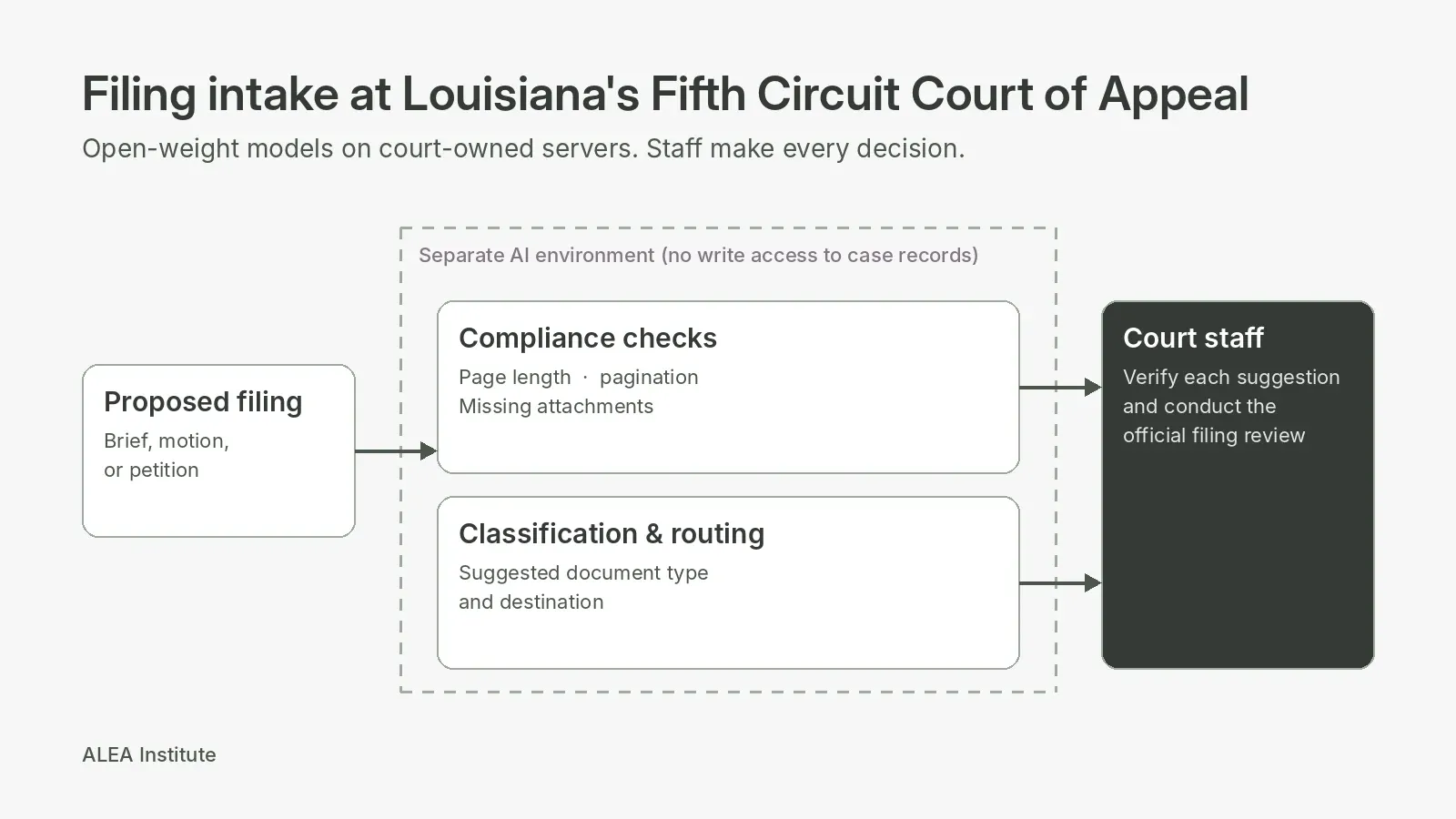
The work began with interviews. Court employees described their daily workflows, and those interviews pointed to the tasks where software could help most. The first applications focus on two of them:
In both cases, the software makes a suggestion and a person decides. Court employees verify each suggestion and still conduct the official filing review. The AI environment is kept separate from the court’s case-management system, and the first applications produce information for staff to evaluate. They do not change the official record.
The court has named several further possibilities. One is checking pleadings for nonexistent cases and inaccurate quotations, a problem courts across the country now see in AI-assisted filings. Lawyers would remain responsible for their filings, and staff would continue to review them independently. Another is detecting hidden instructions placed in a document to manipulate an AI system that reads it.
Further out, the court plans to explore whether AI can help appellate staff attorneys prepare neutral bench memoranda by organizing the record, the briefing, and the cited authorities.
We founded ALEA on the belief that public trust in AI depends on building it within our legal systems and ethical frameworks, through open research. Few places test that belief more directly than a working courthouse.
Running open-weight models on the court’s own hardware means the court can see which model is running, keep its documents in its own building, and measure costs directly. It also builds technical expertise inside the court, rather than leaving all of it with a vendor. The judges have been clear that owning the hardware brings its own obligations: power, cooling, maintenance, and cybersecurity. Keeping a system on the premises does not by itself make it secure.
We are equally glad that the court chose to compare approaches instead of picking a side. Courts need evidence about where AI helps, where it does not, and where human judgment has to stay in charge. A side-by-side test in a working court is how that evidence gets made.
Lawyer Monthly describes this as what appears to be the first publicly announced effort by a US state court to buy dedicated AI infrastructure for building its own applications. Judge Schlegel and Chief Judge Chehardy have not suggested that every court should do the same. Their goal, and ours, is to learn what works and to share it.
The court has said from the start that this technology is meant to support its employees, not replace them or make judicial decisions. That is the right line, and the project is designed to hold it: the first tools check filings for mechanical problems, the AI environment cannot write to the court’s records, and every suggestion goes to a person.
We are grateful to Judge Schlegel, Chief Judge Chehardy, and the staff of the Fifth Circuit Court of Appeal for the chance to work alongside them. We will share what we learn as the work continues.
If you work in or with a court or another public institution and want to talk about a similar project, please contact us or see our collaboration page.