
Why Communities Fight Data Centers

Draft working paper — a framework for understanding community opposition to the U.S. data center buildout.

Beneficiary
Date
Work
Draft working paper — a framework for understanding community opposition to the U.S. data center buildout.

In collaboration with:
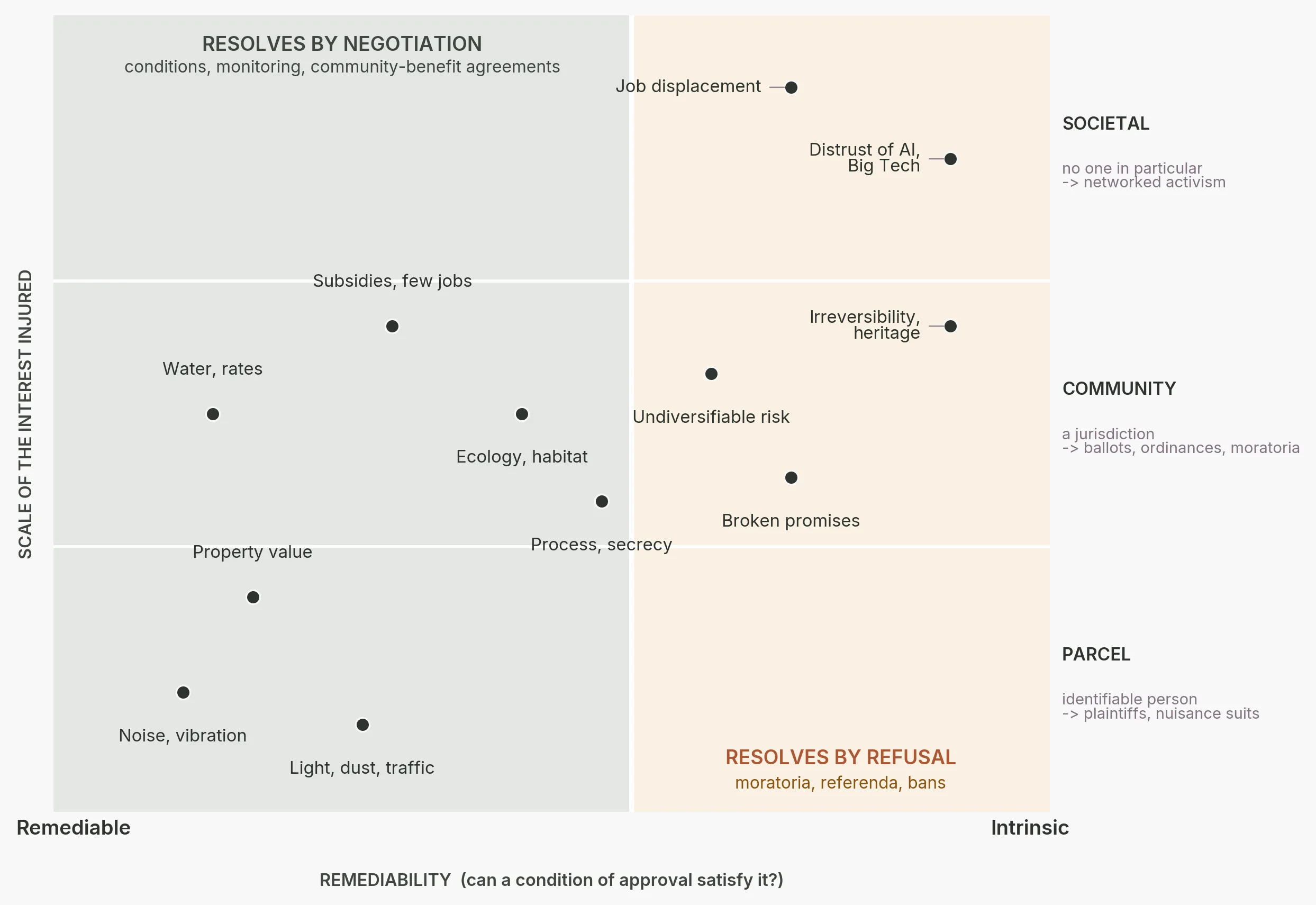
A two-dimensional framework mapping data center grievances by remediability and the scale of the interest they injure

Draft Working Paper

This is a working draft (July 2026) circulated for comment. Figures, classifications, and findings are subject to revision, and the empirical figures move quickly. Read the draft (PDF).

Why Communities Fight Data Centers: A Framework for Understanding Opposition to the American Data Center Buildout


In roughly two years, opposition to data center development in the United States has grown from scattered local complaints into an organized national movement that now blocks or delays tens of billions of dollars in projects each quarter. This draft working paper argues that the opposition is neither irrational nor merely parochial, and that the common “NIMBY” label obscures more than it explains. It offers a framework for making sense of the grievances communities raise and predicting how each is likely to be resolved.

Read the Draft Working Paper (PDF): This is a working draft circulated for comment; the empirical figures are current as of mid-2026 and should be reconfirmed before they are relied upon.

Two Structural Facts


The argument rests on two facts about how these projects are built:

  • The benefits flow broadly while the costs concentrate locally. A data center serves a national or global company and a national ambition in artificial intelligence; the noise, water draw, truck traffic, higher electricity bills, and lost farmland are borne by the few thousand people who live nearby.
  • The binding constraint is electric power, not community consent. Developers go where a utility can deliver the load on their timeline, which is why projects land on cheap rural land near high-voltage transmission, and why residents so often feel the decision was made upstream, before anyone asked them.

A Framework: Three Axes of Grievance


The paper sorts community grievances along three axes that together predict how a fight behaves:

  1. Remediability — whether a condition of approval could satisfy the grievance. Noise, wells, rates, and property values can be bought off through binding conditions and community-benefit agreements; irreversible land loss, a broken process, and opposition to AI itself cannot. This axis predicts the resolution channel: remediable grievances end in negotiated terms, intrinsic ones in moratoria and referenda.
  2. Scale — whether the injured interest is a parcel, a community, or society at large. Scale predicts who mobilizes, from a single plaintiff to a networked national movement.
  3. Project phase — announcement, construction, operation, or enforcement. Grievances activate at different times, from the secrecy that dominates the announcement to the broken promises that surface only at enforcement.

What the Evidence Shows


  • Opponents blocked or delayed roughly 75 projects worth about $130 billion in the first quarter of 2026 alone, the most on record, as active opposition groups more than doubled over the same period.
  • Opposition is strikingly bipartisan: about 71% of Americans would oppose a data center built in their area — 75% of Democrats and 63% of Republicans — with the most conservative Republicans closer to Democrats than to their party’s center.
  • More than 200 local moratoria across 30 states now restrict data-center development, concentrated in a handful of Midwestern and Southeastern states that are also among the fastest-growing markets.
  • The local economic case is weak where it lands: roughly $13 million in capital per permanent job, against about $137,000 elsewhere in the economy, with incentives that frequently exceed a million dollars per job.
  • The disputes residents actually win in court are procedural — challenges to how an approval happened, not to whether a data center is good — as in the defeat of Virginia’s Digital Gateway.

Why It Matters


The framework distinguishes the grievances that better rules can resolve — disclosure requirements, approvals tiered by size and load, separate utility rate classes, enforceable conditions — from those that only a siting or moratorium decision can reach. Its central prediction is testable against the growing archive of ordinances and agreements: remediability sorts the outcome. And it clarifies a trajectory, as a rising share of opposition treats the facility as a proxy for artificial intelligence and the firms behind it — opposition that no better deal will satisfy.

Contact us

Want to talk or collaborate?

Don't be shy. We'd love to hear from you.

Subscribe


News and Updates from the ALEA Institute.